Four Google clicks a day, and the orders keep coming.
BlankSlate Innovation makes nuclear track detectors, isotope analysis instruments and specialty deuterides in Lubbock, Texas. Its buyers are physicists, radon labs, teaching labs and gas operators, scattered across the world and each searching for something very specific. This is how the site was built to be found by them — by Google, and by the AI assistants they increasingly ask first.
70 pages · Search & AI visibility · Lubbock, Texas
Ten buyers a month, and every one of them specific.
BSI sells CR-39 detector chips for neutron, alpha and radon measurement, a tabletop FT-ICR mass spectrometer for light isotopes, helium-3 testing for natural gas wells, a data-logging breath analyzer and a shelf of metal deuterides. None of these is something a person buys on impulse, and almost nobody searches for them by a general name.
The people who do search type exactly what they need: boron-coated CR-39 for thermal neutrons, an alternative to TASTRAK, how much helium-3 is in my gas well. Keyword tools report most of these as zero searches a month. They are not zero. They are a handful of people, and each of them has a budget.
A five-page site with a “Products” page cannot answer those questions, so it never appears for them. And more and more, these buyers are not searching at all. They ask an assistant, which reads the web on their behalf and comes back with two or three names. The job was to make BSI one of those names, for the right questions, with the right facts.
Six decisions, in the order they mattered.
None of this is exotic. Most of it is discipline — the kind that is easy to skip on a normal site and expensive to skip on this one.
-
01
One page per question a buyer asks.
Products got their own pages, and so did the jobs people buy them for: passive neutron detection, radon, university teaching labs, helium exploration. Then the questions that sit around a purchase: what CR-39 actually is, how to switch from TASTRAK or BARYOTRAK without losing calibration, how international orders ship and get paid for.
Why it mattersAn assistant answering “where can I buy CR-39 outside the UK?” needs a page that says so in plain words. If no page does, it cannot name you.
-
02
The same facts, word for word, everywhere.
Price, thickness, minimum order and lead time are written once and repeated identically on every page that mentions them. When the standard chip thickness moved from 0.9 mm to 0.75 mm on 28 September, twelve pages and both AI summary files changed in a single update.
Why it mattersWhen two of your pages disagree, an assistant has to pick one, hedge, or leave you out. Consistency is the cheapest credibility there is.
-
03
Prices on the page.
Standard CR-39 is $2 per cm², boron-coated is $5, with a $100 minimum. Helium-3 testing is priced per sample. All of it is published, rather than hidden behind “contact us for a quote”.
Why it mattersAn assistant can only quote a number that exists in public. Look at the answers below: four of the five quote a BSI price. “Contact us” gives it nothing to say.
-
04
A plain-text map written for machines.
Two files at the root of the site,
Be honest about this onellms.txt(58 lines) andllms-full.txt(583 lines), describe every product and service in plain language: what it is, what it costs, how long it takes, where it ships — and what BSI does not sell.llms.txt is a proposal, not a standard, and nobody can show it is why an assistant chose BSI. It is cheap to write, so it was worth doing. It is not a secret weapon.
-
05
The door left open for AI crawlers, by name.
BSI’s robots file allows the crawlers that AI search tools use — OpenAI’s, Anthropic’s, Perplexity’s, Bing’s — one by one, and keeps a few off-topic tool pages out of every index so they do not muddy what the site is about.
Why it mattersSome hosts and security plugins block AI crawlers by default now. A site an assistant cannot read is a site it cannot recommend, however good the pages are.
-
06
The limits, written down.
BSI analyses exposed detectors with electron microscopy and AI, and the honest answer to “how accurate is it?” is “it depends on the sample”. So the site says that, and publishes no accuracy figure for track analysis at all.
Why it mattersAssistants repeat what you publish. Publish a number you cannot always hit and an assistant will quote it, confidently, to someone who will hold you to it.
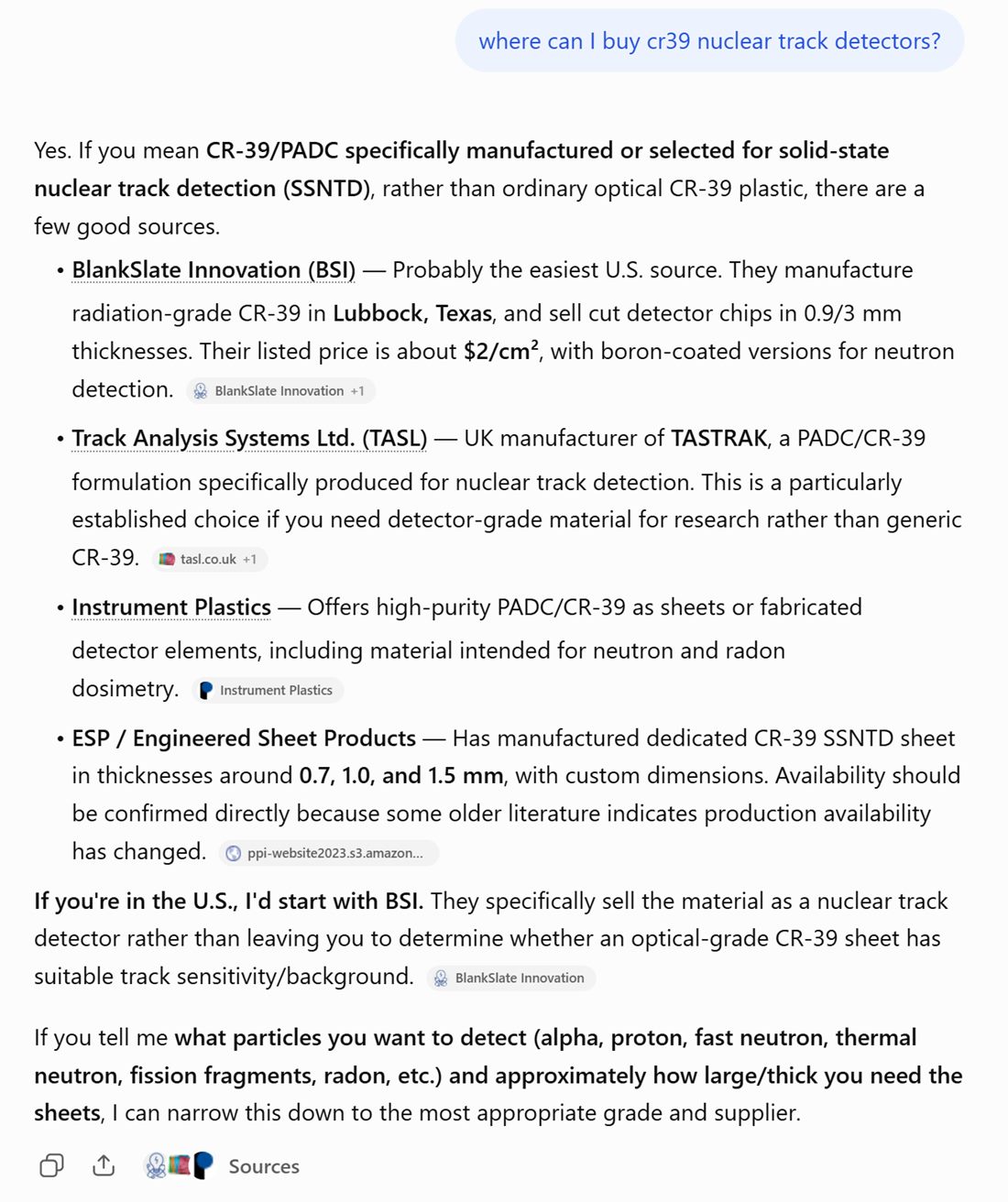
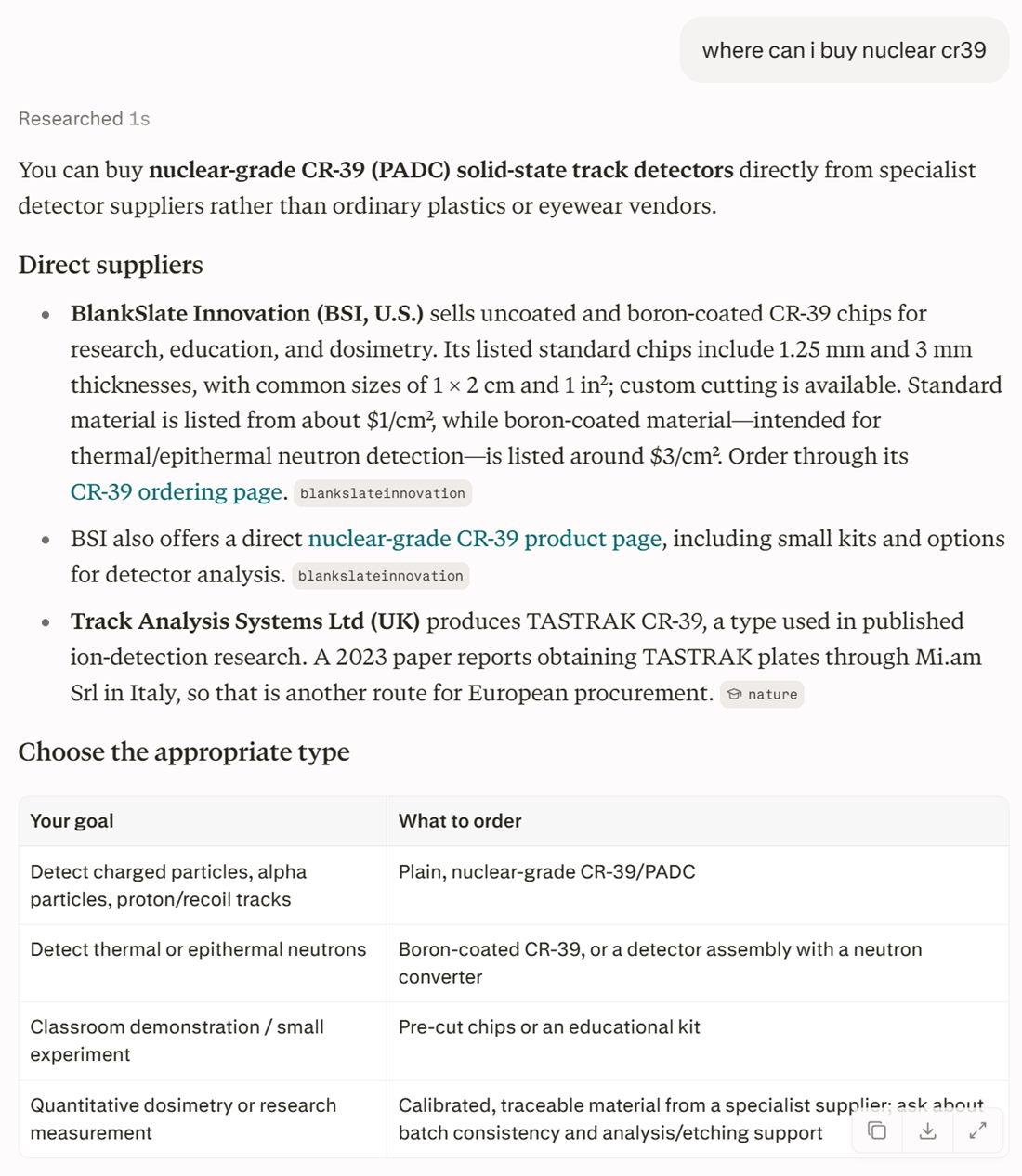
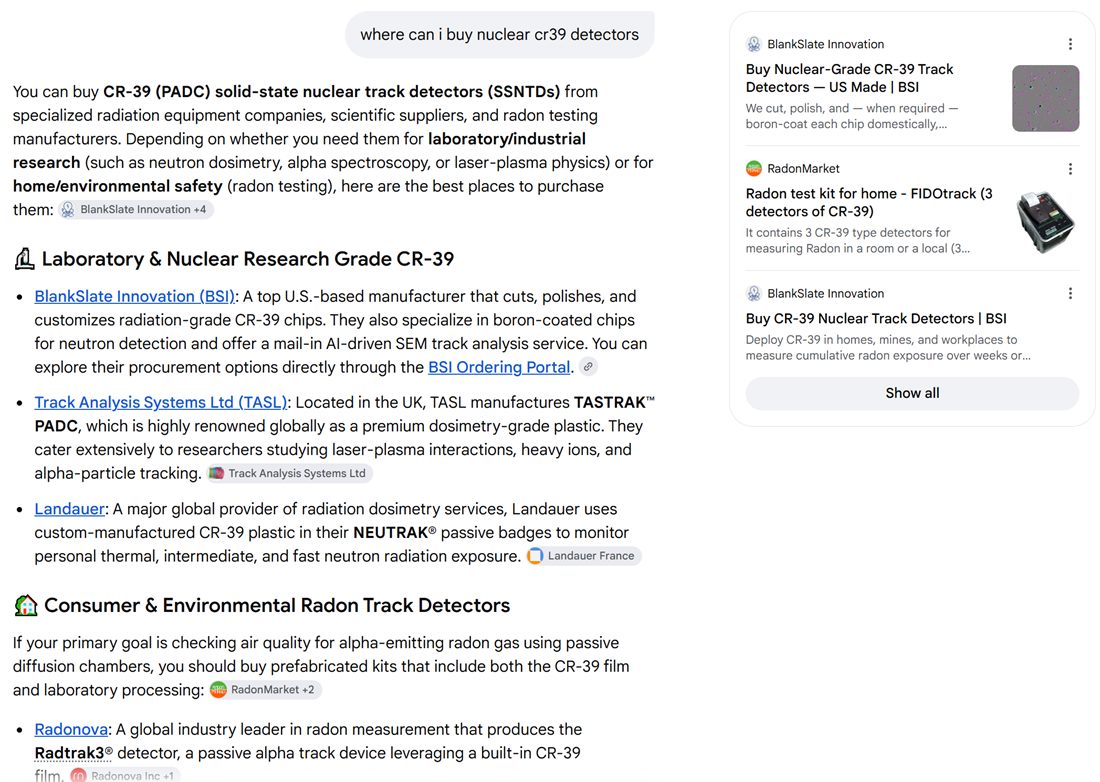
Five questions. Five times, BSI first.
All five were run logged out on 5 October 2026, so no account history shaped them, and none of the questions names BSI. Answers change from run to run and from person to person, so read these as five honest samples, not a ranking anyone can promise.
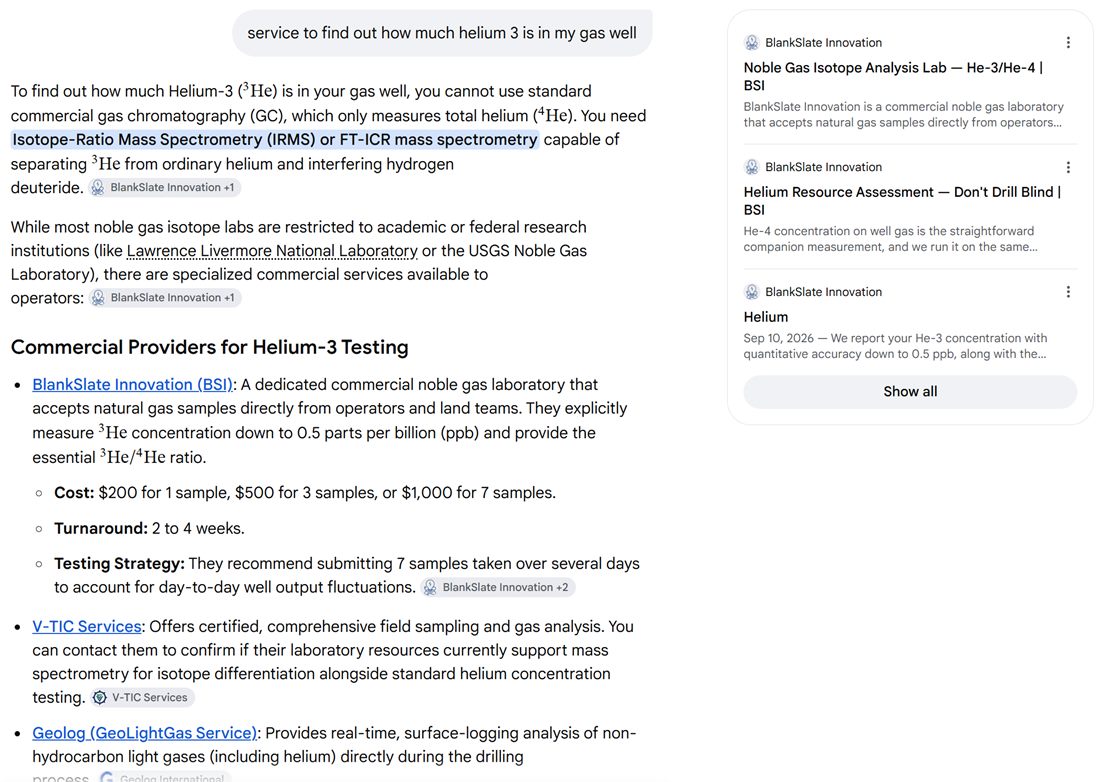
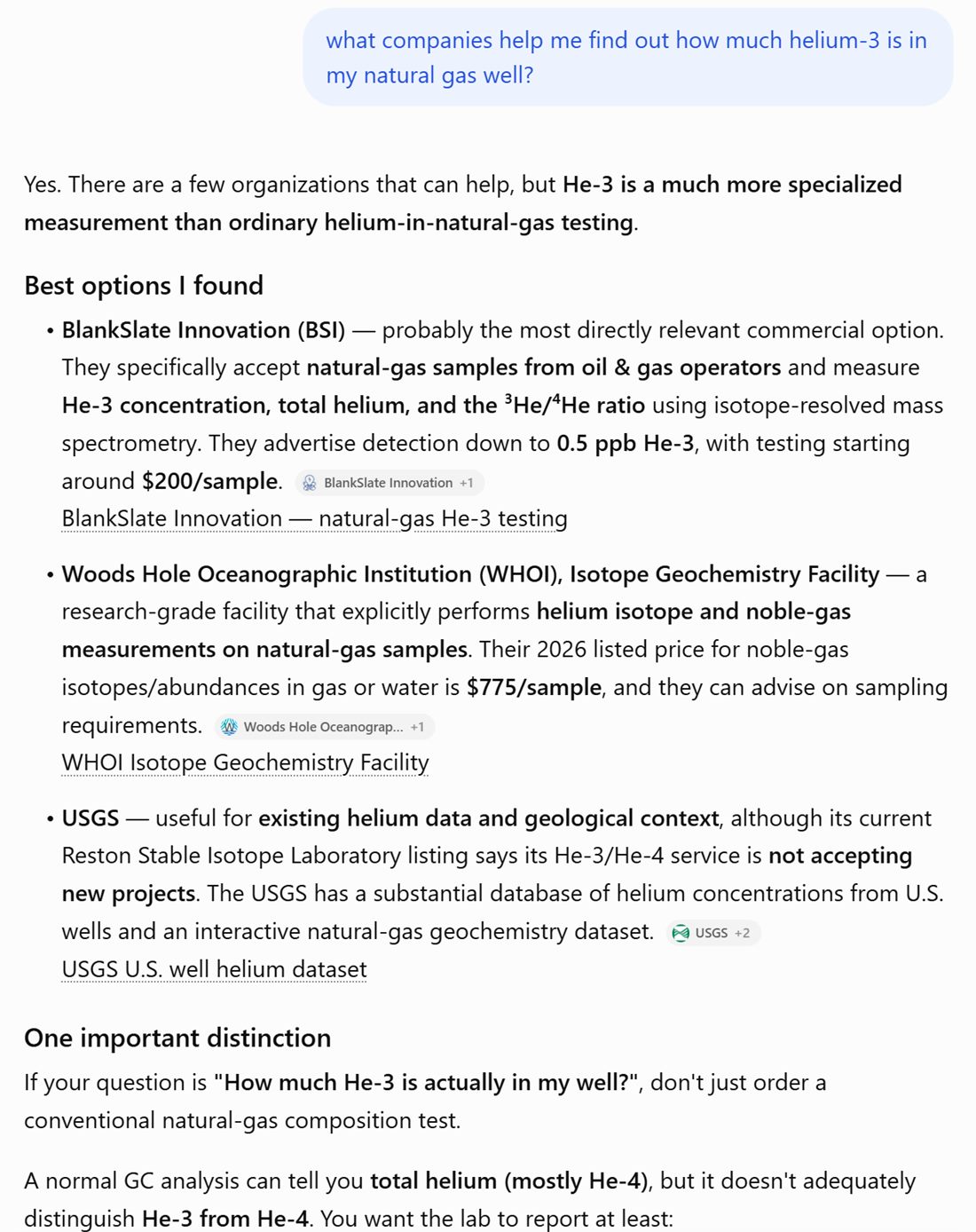
A different product, a different buyer, the same result.
Helium-3 testing has nothing to do with detector chips. It is sold to gas operators and land teams, not physicists, and it lives on its own pages. Both assistants still found it and named BSI first — because those pages answer that exact question in plain words, with a price attached.
Search Console cannot see most of this.
What the numbers show, what they do not, and the one thing the screenshots got wrong.
BSI received 455 clicks from Google in sixteen weeks. Among the searches Google reports, the brand name brings in more clicks than every product search combined. The best product search, “cr-39 detector”, sat around position eight and sent three visitors.
By ordinary SEO standards that is a quiet site. And yet orders went from one $500 order every few months to around $4,000 a month, and about 90% of CR-39 orders now come from people who found BSI through Google or an AI assistant. Set that beside a site with almost no product-search clicks and the pattern is hard to miss: buyers are given the name first — mostly, BSI believes, by an assistant — and then search for it. When an assistant links straight to a page, the visit often arrives with no label at all.
Fits is the honest word. Analytics alone cannot prove how much of that is AI, and we will not pretend it can. That is the measurement problem with AI search, and it is why the screenshots exist: the only reliable way to know what assistants say about you is to ask them, the same way, and keep the receipts.
What the answers got wrong
Two of the five answers quote figures BSI no longer uses. ChatGPT was still giving the old 0.9 mm thickness a week after BSI changed it. Perplexity gives 1.25 mm and prices of $1 and $3 per cm². BSI’s own pages all say 0.75 mm, $2 and $5 — we checked every one — so the assistants are working from older copies of the web.
That is the most useful thing on this page. Assistants lag. Change a price and old answers will keep circulating for a while, and the only way to know when they catch up is to look. It is also why being consistent matters so much: the fewer versions of your facts exist online, the fewer wrong ones there are to repeat.
“Noah is incredibly diligent and open to feedback for web design. We get compliments on the website every time we show somebody new. Brought us from one $500 order every few months to about $4000 of orders monthly within just 3 months from the SEO. I didn’t know that was possible without real marketing!”
Dr. Robert Duncan — BlankSlate InnovationYou do not need to sell detectors for this to apply.
A fence company and a physics supplier have very different buyers. The mechanics of being recommended are the same.
Answer the question, not the keyword.
One page for each thing a customer actually asks about before they buy, written so a stranger could act on it.
Say it the same way everywhere.
Name, prices, hours and service area, identical on your site, your Google profile and every listing that mentions you.
Measure answers, not only traffic.
Ask the assistants your customers use the questions your customers ask. Screenshot them. Ask again next month.
How AI search works for a local business Websites for deep tech & scientific companies
Book a scoping call
Tell us what you make and who buys it. We will look at what your buyers search for, what your current site answers and what it leaves to email, and tell you honestly what the build would involve.
- You talk to the physicist who will write your pages
- A firm quote in writing after the call, not a proposal deck
- No obligation, and no follow-up sequence if it is not a fit
Grab a time that works for you.
Open the calendarOpen the calendarLet’s get your phone ringing.
Fifteen minutes, no obligation, and you will leave knowing exactly what to fix first.